What we had already observed in practice is now independently supported by an evaluation conducted within the UK care system: once Nobi is installed in care communities, fall-related incidents are detected earlier, escalation to emergency services decreases, and hospital utilization is reduced, with associated system-level cost impact.
The evaluation was commissioned and published within the UK’s National Health Service (NHS) by the Suffolk & North East Essex Integrated Care Board (SNEE ICB) as part of a publicly funded digital care modernization program. It examined outcomes across seven care communities (87 resident rooms), combining quantitative service-utilization data with qualitative feedback from staff, residents, and families.
While conducted in the UK, the challenges it addresses — avoidable hospitalizations, EMS burden, night-time risk, staffing pressure, and family trust — are shared across senior living systems globally, including the US.
Results at a glance
Across the participating communities, the evaluation reports:
- fewer fall-related hospital visits, admissions and ambulance callouts
- dramatically shorter hospital stays when admission occurs
- more complete incident visibility (more recorded falls, fewer escalations).
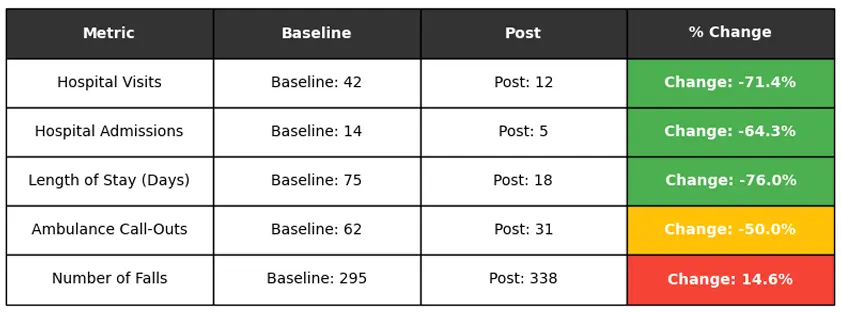
The evaluation’s interpretation is explicit: these outcomes indicate earlier detection, faster response, and safer on-site management of falls, not delayed or avoided escalation.
The strongest signal lies in the combination: fewer hospitalizations and a much shorter length of stay. This is what drives the greatest system-level impact, reducing pressure on acute care capacity while keeping residents safely supported within their care community.
Why recorded falls increased, and why that’s a positive signal
The evaluation addresses this directly: the increase in recorded falls reflects improved detection of previously unwitnessed or self-resolved fall events, not increased fall risk.
At the same time, ambulance callouts and hospital admissions declined, indicating greater visibility with less unnecessary escalation.
What changed in day-to-day care
Beyond the numbers, the report documents consistent changes in daily practice once Nobi became embedded into routine care.
Across communities, staff report:
- higher confidence, particularly during night shifts;
- less guesswork and faster triage after incidents;
- stronger documentation supporting regulatory confidence;
- clear cultural adoption (described as “embedded into daily practice”).
Families describe the same shift in clear, human terms:
- clearer explanations when incidents occur;
- reduced guilt around care placement;
- increased peace of mind.
In at least one documented case, the presence of Nobi influenced the choice of care community.
Taken together: better fall insight strengthens judgement on the care floor, and builds trust with families.
System-level value
The evaluation’s cost analysis is grounded in observed clinical outcomes, not vendor assumptions.
Using conservative UK public healthcare reference costs, the evaluation estimates:
 ≈ $110,000+
in avoided fall-related emergency-care costs
over six months

≈ $690,000+ avoided costs
over three years
 ROI
ROI
over three years
 Payback
The report explicitly notes that these figures represent system-level avoided costs, not provider-specific savings or optimistic projections.
Beyond falls: moving towards predictive care
While falls were the primary focus, the evaluation also documents real-world use of Nobi data beyond immediate fall response.
Care teams reported using Nobi insights to support earlier, more proactive care decisions, including:
- sleep disruption patterns supporting earlier detection of UTIs;
- behavioral health monitoring;
- epilepsy pattern recognition;
- self-harm risk monitoring;
- mental-health and medication reviews.
These applications are described as current practice, not future potential. Together, they position Nobi not as a single-use fall solution, but as care infrastructure that supports predictive and preventative care.
Raising the standard for care
The evaluation itself is explicit in its conclusion. In the context of accelerating digital transformation and growing pressure on health and care systems, smart fall-prevention technology should not be treated as optional innovation.
Instead, the report calls for intelligent monitoring to be progressively normalized within care quality frameworks, digital maturity pathways, and falls-prevention strategies — positioning it as a recommended standard within care system expectations.
For Nobi, this conclusion directly reflects how we design and position our technology: not as an add-on, but as care infrastructure that belongs in the standard of care.
Wondering what this research means for your care environment?
Read a preview of the ICB-study here.
Please provide your details to receive the full report, or contact us for further information.